Suzanne Pyle

Suzanne Pyle

   XtoRays.com is dedicated to promoting the benefits of digital infrared thermal imaging. This non-radiation method for detecting pathology is one of the most useful technologies that exist today. 
   I hope that this web site will address all of the questions and concerns you might have.

Sincerely,
Suzanne Pyle, MS, CCT

Biography

   Suzanne Pyle is a Certified Clinical Thermographer and has been active in women’s health issues for the past 30 years.  As a teacher, trainer and area manager for Aerobic Dancing, Inc., she introduced hundreds of women to the benefits of physical fitness (many for the first time in their lives).
   Since earning a Master’s Degree in Human Nutrition from the University of Bridgeport in 2001, she has successfully counseled both men and women in proper nutrition and health issues.
Suzanne is presently Treasurer and Director of Professional Nutrition Associates, a tri-state organization dedicated to finding cutting edge nutritional solutions to health problems.


welcome

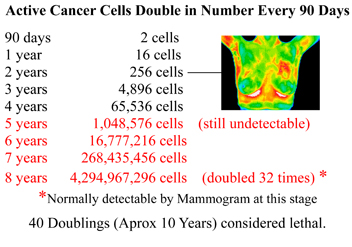
Cell Doubling Rates

Thermal Imaging can detect growth patterns in the 2nd year.  Why wait until it's too late?


Breast Thermography Video

Current research has determined that the key to breast cancer survival rests upon its earliest possible detection. If discovered in its earliest stages, 95% cure rates are possible. Thermograms detect cancerous activity 8 years before a mammogram can detect a tumor.


What is a thermogram?

    A thermogram, or as it is also called, Digital Infrared Thermal Imaging, is a  FDA approved method of measuring patterns of heat emitted from the body,  In relation to breast cancer, a thermogram detects angiogenesis which is the growth of new blood vessels. These new blood vessels feed a tumor and they show up as higher temperature in breast tissue.

What is the difference between a thermogram and a mammogram?

    First, these are two entirely different methods of screening for breast cancer and thermograms in no way replace mammograms.  Mammograms detect structure or anatomy such as a tumor; thermograms detect a process or physiology like inflammation or angiogenesis.
Second, mammograms use radiation and compression; thermograms use neither – so there is no damage to fragile, cellular DNA and there is no risk from radiation (and even though mammograms use low radiation, THERE IS NO SAFE LOW RADIATION). For women with BRCA 1or 2, please click on "Research" and then "Clinical Studies."
    Third, thermograms view a larger area (all the way up parallel to and under the arm pit) which is one of the reasons why they have a better detection rate.
    Fourth and most importantly, because thermograms detect the growth of new blood cells, they detect cancerous conditions in the breast up to 8 years before a mammogram can detect a tumor.  So since no one knows how to prevent cancer, early detection seems to be your best chance for overcoming this dreaded disease.


More Frequently Asked Questions...